27 May 2009
Pritchett on Cary's Irish irony
13 May 2009
Achebe takes on Cary
Quoted from "Home and Exile" by Chinua Achebe, published in the magazine The African Business, June, 2003 (in an interview with Michael Thelwell Achebe is also quoted as writing Things Fall Apart in response to Cary -- his novel went on to be perhaps the most widely read of all 20th century African literature).
12 May 2009
Double-Distilled Melancholia
Letter from James Henry Cousins to ? 4.27.1899:
- “Did not I tell you I’d go raving mad after the (2) ecstasy of that ramble. I promptly developed a fit of thoroughbred double-distilled melancholia! This is dear mother nature’s usual plan of making me pay up for excess of enjoyment; but, like laughing, it’s nothing when one’s accustomed to it. And it is usually in such periods of gloom that some idea gets into my cranium, like the pain of sand in the oyster, around which the succulent bivalve casts a garb of pulp that only becomes a pearl to shine on my lady’s brow." (1-2)
- "Ah! how happy this poor old world would be if only people followed a star; a real, substantial, honest star, instead of the wills-o’-the-wisp that are so plentiful! That star has got into my imagination: I am still following it: I hope I (and the person who glorified its shining by (4) an apt thought) may find like the shepherd’s of old, if not the young child, at least the spirit of purity, truth, and wisdom which he came to show forth." (3-4)
- "I want to scale Killiney on Saturday, if weather permits. You know the way: will you act as my 'guide, philosopher, and friend'—chum, purely platinum!" (4)
Bowen's Christmas card
I'm not entirely sure where this could be included--it's from a lovely gift edition of the essay--but if we do something about Christmas, or Anglo-Irish views of the "simple life," or simply something about the imagination, it could be useful.
- "Each of us, probably, has in mind one ideal and absolute of the Christmas card, as received in childhood. My own taste (date around 1910) is this—I behold a cottage gable in deep, dusky silhouette against an inspiring gleam of sunset, one window lit; smoke goes up from the chimney. To this, a woodman returning, footprint by footprint, across the foreground snow; all around stretch white wastes, the bare trees are dark. How it glows and glows through that one small window—core of the world, magnet to man, the home! Towards it, the coach lurches among the drifts, the cravatted rider whips up his horse, the red-mittened children drag their laden sledge, the spotted dog lollops, the cat leads her train of kittens, the crinolined lady picks her delicate way. All Christmas-card-land creatures have the same destination. My woodman’s cottage, crouched in smouldering evening, remains for me forever the symbol-scene—no better picture, before or since, has so fixed for me that light in the falling dark; or, by contrast, the elemental and daunting loneliness of Elsewhere. That sense of the Elsewhere, and of those straying in it, can but encircle Christmas, if one has any heart."
Elizabeth Bowen Goes to London
- All through my childhood, London had a fictitious existence for me. It loomed darkly somewhere at the other side of the water; I thought of it (when at all) as an entity, at once magnetic and dangerous. It was, from all I heard, a city into which no one ventured alone, and which was to be entered only after preparation and wary forethought. It stood for the adult, and so much so that there should be children in London seemed unimaginable—in fact that there should be people of any kind was only a secondary idea: I pictured the thing as a mass of building, a somehow impious extreme of bulk and height in whose interstices was fog. I first crossed the city when I first crossed the sea, when I was 4: it must have been winter, we arrived after dark and were driven as hurriedly as possible from Euston to some other terminus in a cab. The street lamps, seeming dimmer than Dublin’s, showed us to be in the continuous bottom of the chasm, among movement conveying a sense of trouble, and which one suspected rather than saw. My mother, for a minute put down a window, saying, as though in extenuation, “London has a smell of its own.” But this, like all else given off, was nonhuman (74)
- If I had been an American child instead of an Anglo-Irish one, it is possible that London, from being farther in the distance, would have been more clear-cut as an idea: I should have had some rational notion of it, instead of being infested by it imaginatively. As it was, it was like a hand too near my eyes. Nobody ever told me about London, or explained to me what it was—I was assumed, I suppose, to have been born knowing. This must have come from the Anglo-Irish ambivalence as to all things English, a blend of impatience and evasiveness, a reluctance to be pinned down to a relationship—one which, all the same, nobody could have conceived of a life without. So for what seems a long time London remained partly a not quite convincing fiction, partly a symbol of ambiguity, partly an overcast physical fact. (75)
- I found myself in the same room as Edith Sitwell, Walter de la Mare, Aldous Huxley; and I know there were others. I remember almost unearthly electric light broken on brocade-angular folds of one poet’s dress, and her benevolence (she was talking about something lost under a sofa) and the graven face and shining cavern eyes of the other. Of Aldous Huxley I was most nearly frightened, through no fault of his. But alas these images, and se many since, cast themselves on the screen as a silent film: I have a wonderful visual memory but a poor verbal one. I recall little or anything that has been at any time said—the sense and atmosphere of a conversation, yes, but the words, no. And all things considered, this is a tragedy. (79)
10 May 2009
Mirrors open up a room
More Moore, briefly noted
The Catholic Counter-Revolution Will Not Be Televised (or maybe)
Sean O'Faolain gets adjusted
"Anyway, by the time I had more or less adjusted myself to the life about me, it suddenly broke in on me that Ireland had not adjusted herself to the life about her in the least little bit. Irishmen in general were still thinking about themselves, or rather, in their usual way, double-thinking or squint-thinking about themselves, in terms of dawns, and ands, and buts, and onwards, and dew, and dusk, while at the same time making a lot of good, hard cash to the evocative vocabulary of tariff, tax, protection, quota, levy, duties or subsidies, meanwhile carefully compiling a third and wholly different literary style (pious, holy, prudent, sterling, gorsoons, lassies, maidens, sacred, traditional, forefathers, mothers, grandmothers, ancestors, deep-rooted, olden, venerable, traditions, Gaelic, timeworn and immemorial) to dodge more awkward social, moral and political problems than any country might, with considerable courage, hope to solve in a century of ruthless thinking. This ambivalence, once perceived, demanded a totally new approach. I have been trying to define it ever since. For, as long as we were all in a splendidly romantic-idealist fervour about Ireland we could all write romantically, or idealistically, about Ireland, as Sean O'Casey did. (He is sometimes called and probably thinks himself a realist but he is actually the biggest old romantic we ever produced.) Or if we were being realistic we could write in the realist tradition. But for any kind of realist to write about people with romantic souls is a most tricky and difficult business [.]
07 May 2009
The Feast of Lupercal by Brian Moore (1957), p.11
Moore is apparently famous for writing about Belfast.
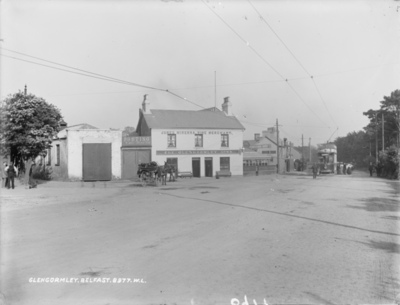
"And at last, the last bell rang. Mr. Devine, as always, was the first master to catch the bus which took them from the suburb of Glengormley to the center of Belfast. He lived midway between the school and the city, in a quiet avenue once prosperous, now failing. Its small front gardens had a naked, communal look, occasioned by the wartime removal of their iron railings for us in making tanks. The railing had not been replaced, the avenue had not recovered. Dusty squares of lawn, enclosed by low stone parapets, lay like neglected empty pools in front of the houses. It was an avenue whose first owners had moved to new areas, making way for widows with annuities, salesmen on commission and policemen pensioned off. Most of the houses took in boarders and some have converted their basements into flats for single gentlemen."
Please post a photograph of Belfast, either from your own store or elsewhere. I'll follow up in what's been written about Moore when I can get back to Firestone.
06 May 2009
Bowen's Jingling Syntax
“When her editor questioned some of the contortions, Bowen replied: ‘I’d rather keep the jars, “jingles” and awkwardnesses – e.g. “seemed unseemly,” “felt to falter”. They do to my mind express something. In some cases I want the rhythm to jerk or jar – to an extent, even, which may displease the reader.’” (from Maud Ellmann, Elizabeth Bowen: The Shadow Across the Page, 166, note 57: Letter to Daniel George, 2 June 1948, HRHRC)
Mss letter to Daniel George, in Princeton "Milberg Misc. Mss." file, 18.4.49: “I wondered if I’d been a bit harsh of Angus Wilson, but I hate noisy “strong” writing, and also still more writing that’s a discharge of decaying matter from the system. I felt A.W. was intelligent enough to merit a rap. And that Sean O’F., who to my mind as a reviewer resembles an old nanny-goat teetering over a rock garden, just as much as he’s an eagle, at his best, in stories and novels, more than makes up to A.W. for my deficiencies.”
The relevant passages from The Heat of the Day:
à Pg. 11: “Lest this be too subtle, his tone was unkind enough to drive at least his will to unkindness home – it did: she withdrew from the pocket her other hand in order to, self-protectively, fold her arms. She could be felt to falter behind the barricade; and the programme, let go of by her as though incriminated, fluttered to the ground.” (passage at concert, goes on to musicians’ “black, seated bodies had fastened to them the faces and hands of ghosts”
à Pg. 236: But this evening for Louie had rung the knell of Harrison, man of mystery, as a subject…It seemed unseemly, even, that his companion should have claimed for him the prerogative of pain: Louie simultaneously felt he could never suffer and wished he might.”
A Hireling's Job
Orwell on Birmingham
Orwell, in his essay “Good Bad Books” (2 Nov. 1945), writes, “A type of book which we hardly seem to produce in these days, but which flowered with great richness in the late nineteenth centuries, is what Chesterton called the ‘good bad book’: that is, the kind of book that has no literary pretensions but which remains readable when more serious productions have perished….But apart from thrillers, there were the minor humorous writers of the period. For example, Pett Ridge – but I admit his full-length books no longer seem readable – E. Nesbit (The Treasure Seekers), George Birmingham, who was good so long as he kept off politics…” (in All Art is Propaganda: Critical Essays, pg. 248-49)