10 May 2009

The Catholic Counter-Revolution Will Not Be Televised (or maybe)

I finished Brian Moore's 1972 novella Catholics on the train to NY this weekend:  it's quick and worth a look.  The plot, set vaguely in the near-future, concerns an American priest sent by Papal authorities to a small island off the west coast of Ireland, where Abbot Tomas and the other monks are refusing to follow dispensation of "Vatican IV," which has abolished Latin Mass, private confession, and has opened talks about a merger of the Catholic Church with Buddhism.  But of course the book is really a debate with itself over the effects of Vatican II, seven years earlier, and an interesting disquisition on globalizing Ireland and the tourism industry.

Abbot Tomas gives a speech in which he maintains the old order:  "And the Mass was said in Latin because Latin was the language of the church and the church was one and universal and a Catholic could go into any church in the world, here or in Timbuktu, or in China and hear the same Mass, the only Mass there was, the Latin Mass.  And if the Mass was in Latin and people did not speak Latin, that was part of the mystery of it, for the Mass was not talking to your neighbor, it was talking to God" (57).  This form of linguistic universalism describes a global culture explicitely set against the globalism of the pervasive "human interest" eye of the BBC and American television, who have brought scads of tourists to the small, "authentic" community by broadcasting Muck Abbey's local enclave to the world:

"Ah, for goodness sake don't you know that's a helicopter, it could not fly all the way from Rome.  Ah, so you came in a bigger airplane, did you?  I see.  From Amsterdam to Shannon and then from Shannon by car.  And the helicopter was only because of Padraig.  So that was the way of it.  Do you know, Father Kinsella, I hear tell there is not a village in Ireland that does not have some class of airfield nearby.  Isn't that amazing.  Yes, yes."  (70-71)

"'The idea of Catholics confessing their sins in private to a priest has been distasteful to other groups within the Ecumen brotherhood.  Now that the easier form has been sanctioned by Vatican IV -- you have read the debates, surely?'
'I have, indeed,' the abbot said, 'I know that I am not in step, in the matter of confessions.  But, remember, I tried to limit the confessions to people from our parish.  It was all part of the same thing.  We did not want to disturb the faith of the local people.  Still...'  The abbot paused and looked searchingly at his visitor.  'You said yourself that Rome did not know about the private confessions, You were not sent here because of that?'
'No.'
'Why were you sent, Father Kinsella?  What, in particular, caused this -- ?'  The abbot picked pu father general's letter.
'American television is planning to do a special one-hour program on what has happened here.  Did you know that?'
'So that's it!'  The abbot made a fist of his right hand and hit the top of his desk.  'The damned television!  I did not want television here.  I will ban them.  I was dead against it from the start.'
'Even the president of the United States can't ban American television.  If the networks want to televise what's going on here, it will be done.  And it will be seen all over the world.'
'I warned our monks and I told the merchants at Cahirciveen the selfsame thing, I said don't have anything to do with those telly people, just tell them it's none of their concern.  I refused them permission for any filming on church property.'
'It didn't do much good, did it?  Don't you see that even your action in refusing to let these ceremonies be filmed can lend a significance to them that you never intended?'"  (80-81)

-->  One thing to do will be to look for TV reports on such local communities:  BBC in particular.

Sean O'Faolain gets adjusted


"Anyway, by the time I had more or less adjusted myself to the life about me, it suddenly broke in on me that Ireland had not adjusted herself to the life about her in the least little bit.  Irishmen in general were still thinking about themselves, or rather, in their usual way, double-thinking or squint-thinking about themselves, in terms of dawns, and ands, and buts, and onwards, and dew, and dusk, while at the same time making a lot of good, hard cash to the evocative vocabulary of tariff, tax, protection, quota, levy, duties or subsidies, meanwhile carefully compiling a third and wholly different literary style (pious, holy, prudent, sterling, gorsoons, lassies, maidens, sacred, traditional, forefathers, mothers, grandmothers, ancestors, deep-rooted, olden, venerable, traditions, Gaelic, timeworn and immemorial) to dodge more awkward social, moral and political problems than any country might, with considerable courage, hope to solve in a century of ruthless thinking.  This ambivalence, once perceived, demanded a totally new approach.  I have been trying to define it ever since.  For, as long as we were all in a splendidly romantic-idealist fervour about Ireland we could all write romantically, or idealistically, about Ireland, as Sean O'Casey did.  (He is sometimes called and probably thinks himself a realist but he is actually the biggest old romantic we ever produced.)  Or if we were being realistic we could write in the realist tradition.  But for any kind of realist to write about people with romantic souls is a most tricky and difficult business [.]

"[...]  [W]hen it comes to writing about people who, like the Irish of our day, combine beautiful, palpitating tea-rose souls with hard, coolly calculating heads, there does not seem to be any way at all of writing about them except satirically or angrily.  Once a writer's eye gets chilly about their beautiful souls he becomes like the only sober man at a drunken party, and the only decent thing for him to do then is either to get blind drunk with the rest of the boys (all singing in chorus, 'I'll take you home again, Kathl-ee-eeen') or else to go home and scrub himself clean in a raging satire on the whole boiling lot of them."

--  Sean O'Faolain, from "Foreword."  Selected Stories of Sean O'Faolain.  Penguin 1970.  p.11-12.

07 May 2009

The Feast of Lupercal by Brian Moore (1957), p.11


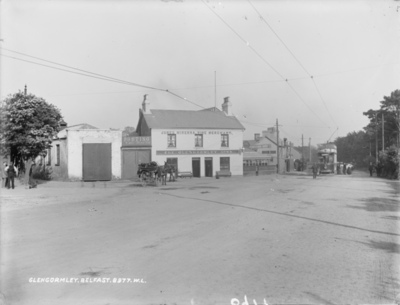
Moore is apparently famous for writing about Belfast.
"And at last, the last bell rang. Mr. Devine, as always, was the first master to catch the bus which took them from the suburb of Glengormley to the center of Belfast. He lived midway between the school and the city, in a quiet avenue once prosperous, now failing. Its small front gardens had a naked, communal look, occasioned by the wartime removal of their iron railings for us in making tanks. The railing had not been replaced, the avenue had not recovered. Dusty squares of lawn, enclosed by low stone parapets, lay like neglected empty pools in front of the houses. It was an avenue whose first owners had moved to new areas, making way for widows with annuities, salesmen on commission and policemen pensioned off. Most of the houses took in boarders and some have converted their basements into flats for single gentlemen."

Please post a photograph of Belfast, either from your own store or elsewhere. I'll follow up in what's been written about Moore when I can get back to Firestone.

06 May 2009

Bowen's Jingling Syntax

“When her editor questioned some of the contortions, Bowen replied: ‘I’d rather keep the jars, “jingles” and awkwardnesses – e.g. “seemed unseemly,” “felt to falter”.  They do to my mind express something.  In some cases I want the rhythm to jerk or jar – to an extent, even, which may displease the reader.’”  (from Maud Ellmann, Elizabeth Bowen: The Shadow Across the Page, 166, note 57: Letter to Daniel George, 2 June 1948, HRHRC)

Mss letter to Daniel George, in Princeton "Milberg Misc. Mss." file, 18.4.49:  “I wondered if I’d been a bit harsh of Angus Wilson, but I hate noisy “strong” writing, and also still more writing that’s a discharge of decaying matter from the system.  I felt A.W. was intelligent enough to merit a rap.  And that Sean O’F., who to my mind as a reviewer resembles an old nanny-goat teetering over a rock garden, just as much as he’s an eagle, at his best, in stories and novels, more than makes up to A.W. for my deficiencies.”

The relevant passages from The Heat of the Day:

à  Pg. 11:  “Lest this be too subtle, his tone was unkind enough to drive at least his will to unkindness home – it did: she withdrew from the pocket her other hand in order to, self-protectively, fold her arms.  She could be felt to falter behind the barricade; and the programme, let go of by her as though incriminated, fluttered to the ground.”  (passage at concert, goes on to musicians’ “black, seated bodies had fastened to them the faces and hands of ghosts”

à  Pg. 236:  But this evening for Louie had rung the knell of Harrison, man of mystery, as a subject…It seemed unseemly, even, that his companion should have claimed for him the prerogative of pain: Louie simultaneously felt he could never suffer and wished he might.”

A Hireling's Job

Elizabeth Bowen letter 15 Oct. 1965:  “I absolutely loathe cooking, and never do anything but grill sausages or scramble or boil eggs – for which, I think, there is no particular receipe?  I think, if I may say so, that this present obsession with cooking is rather awful:  I’m convinced that many people loathe it as much as I do, but haven’t got the nerve to say so.  It’s a hireling’s job, and if one is put to it (I mean, if one is having a party) one can usually find a hireling to do it for one:  otherwise, one eats out.”

Orwell on Birmingham


Orwell, in his essay “Good Bad Books” (2 Nov. 1945), writes, “A type of book which we hardly seem to produce in these days, but which flowered with great richness in the late nineteenth centuries, is what Chesterton called the ‘good bad book’: that is, the kind of book that has no literary pretensions but which remains readable when more serious productions have perished….But apart from thrillers, there were the minor humorous writers of the period.  For example, Pett Ridge – but I admit his full-length books no longer seem readable – E. Nesbit (The Treasure Seekers), George Birmingham, who was good so long as he kept off politics…” (in All Art is Propaganda: Critical Essays, pg. 248-49)